
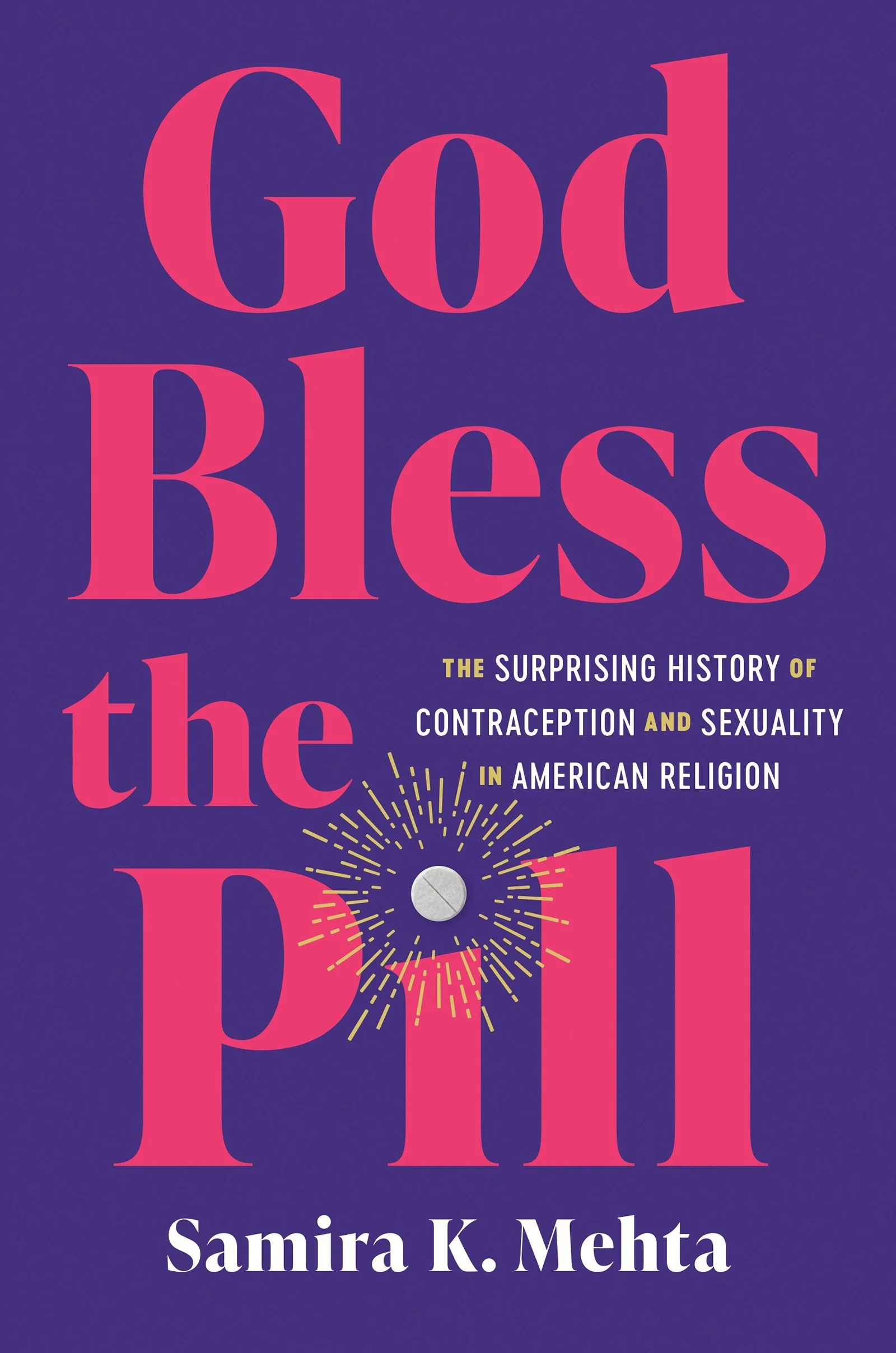
How American religious leaders and their congregations debated—
and embraced—contraception in the postwar era
Most people today understand contraception as central to women’s liberation, and when the birth control pill arrived in 1960, the media thought it would usher in a sexual revolution. But a surprising number of religious Americans in the mid-twentieth century also saw contraception as part of God’s plan—a tool to create happy, prosperous American families in the post–World War II era.
In God Bless the Pill, Samira K. Mehta traces the remarkable story of how mid-twentieth-century Catholic, Protestant, and Jewish voices promoted the use of birth control and made it more accessible for many Americans. They hoped birth control methods would curb divorce rates by encouraging sexually dynamic marriages and families unstrained by “too many” children—thereby creating a postwar upwardly mobile middle class. Religious leaders also promoted this understanding of the family as tied to Cold War capitalism and encouraged neither racial nor gender equity.
But then came the backlash, both from the Right—which failed to anticipate the feminist potential of contraception—and from the Left, where women, particularly women of color, sought to ensure that birth control was a tool of liberation rather than one rooted in patriarchal and racial oppression. Ultimately, Mehta offers compelling new insights into the way religion accommodates itself to social, technological, and medical change.
University of North Carolina Press (2026)

“A brilliant history that holds together religion, race, and economics to give us a deep—and sometimes surprising—account of how cultural discussions of birth control got to where they are today.”
Sarah Imhoff, Indiana University
MORE PRAISE FOR
GOD BLESS THE PILL
“Mehta puts into sharp focus how the views and teachings of Catholicism, Protestantism, and Judaism [on contraception] evolved. . . . A good choice for book clubs as Mehta’s thought-provoking work will stimulate discussion while also showing how religious Americans reacted to the advent of modern birth control.”“Reads like a dream and packs a wallop: The circulation of birth control isn’t the result of godless activists fighting for free sex but that of religious leaders' efforts to meet community needs. Highly recommended.”— Kathryn Lofton, Yale University“If you thought US religious organizations didn’t support contraception, think again. But if you thought religious advocacy would be about feminism, also think again. This book doubly surprises and breaks your heart.”
— Julie Byrne, author of The Other Catholics: Remaking America’s Largest Religion“Mehta expertly demonstrates the power of birth control, and religion, to discipline as well as liberate. This pathbreaking book establishes contraceptive technologies as central to US religious history.”— Kathleen Holscher, University of New Mexico“Revealing a long, often-hidden history of religion and sexual health, Samira Mehta’s groundbreaking account details the high-stakes culture war battles fought over contraception. A powerfully usable, deeply sensitive historical guide.”—Anthony Petro, author of Provoking Religion: Sex, Art, and the Culture WarsMehta "robustly unpacks how the fight for contraception’s availability was often far from a 'tale of feminist victory,' while teasing out the complex beliefs and histories motivating elements of the religious left... an enlightening examination of the tangled intersection of faith, choice, and health in America."